HISTORY THROUGH THE LENS
HABS/HAER/HALS
Photography
and Research
Create Your First Project
Start adding your projects to your portfolio. Click on "Manage Projects" to get started


Avian Disease and Oncology Laboratory, East Lansing, MI
Project type
Cultural Resources Consulting, historic architectural survey
Date
2024-2-25
Location
East Lansing, MI
It was a great privilege to conduct the above-ground cultural resource evaluation of the former Avian Disease and Oncology Laboratory at Michigan State University in East Lansing. I conducted the work in collaboration with my colleague Ryan Duddleston (https://orbisec.com) on behalf of the United States Department of Agriculture. This remarkable facility was first planned and developed by the USDA in the late 1930s, with the land donated by what is now Michigan State University and construction beginning in 1938. The ADOL operated continuously from 1939 to 2024, when USDA combined its functions with a similar facility at the University of Georgia in Athens.
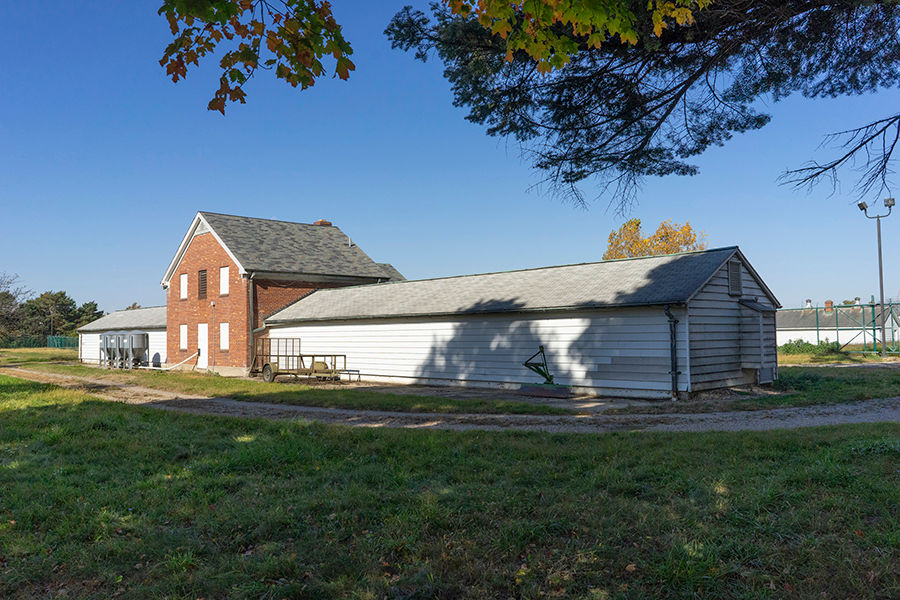
The first five buildings that allowed the new facility to begin operations—a central laboratory, and both a chicken brooder house and an inoculation house to the east and to the west of the laboratory—were completed in early 1939, with other buildings completed by the early 1940s to complete the first wave of construction. Other buildings were added to this original complex beginning in the late 1940s and continued sporadically as needed through the 1990s and early 2000s. The purpose of the facility from its inception was to identify and find cures for diseases that severely impacted the nation’s poultry industry, specifically for chickens; in particular, the facility placed its emphasis initially on what was then called fowl paralysis (now known as Marek’s Disease) which killed millions of chickens per year. In order to conduct the necessary research, the facility also operated as a breeding facility with the intent of identifying and isolating genetic traits to identify and reproduce lines of chickens for use in testing aspects of the diseases under study and their potential cures.
In 1972, what was then known as the Regional Poultry Laboratory complete work on a vaccine for Marek's disease that became commercially available and was in widespread use by 1973, a development that transformed the nation’s poultry industry and was the culmination of the Regional Poultry Laboratory’s original mission.
The facility's buildings are interesting, but not significant on their own. Instead, the landscape design is the significant aspect of what remained in 2024 at the time of my survey. In order to identify the causes of, and to find a cure for, an infectious disease among poultry, research staff at the ADOL needed to maintain complete isolation and quarantine of particular lines of chickens that had been bred for susceptibility to, or resistance from, the diseases under study. The buildings in which the two functions of the ADOL took place—pathology and genetics—thus needed to be kept separate. As a result, the ADOL was designed with a symmetrical plan with buildings placed on a linear axis, accentuated by the typically long, narrow brooder and laying houses on either side of the central laboratory building.
I recommended the complex eligible for the National Register of Historic Places under Criterion A for its association with the internationally significant research conducted at the ADOL, and under Criterion C for its landscape design. The Michigan State Historic Preservation Office (https://www.miplace.org/historic-preservation/) concurred in my recommendation.